Starting or upgrading an atta chakki business is one of the most reliable small businesses in India. But buying the wrong machine — too small, too underpowered, or the wrong stone technology — can cost you lakhs in lost productivity. This guide breaks down everything you need to know before purchasing a commercial flour mill in India in 2026.
Why the Right Machine Matters
A commercial flour mill is not just a purchase — it is the engine of your entire business. A machine that runs 8–10 hours a day at 20 kg/hr will earn you very differently from one running at 70–80 kg/hr. And if your machine breaks down every few months or requires weekly stone dressing, you lose money on repairs AND on missed grinding days.
The two biggest decisions are: (1) What size? and (2) Which stone technology?
Best Machine Sizes for Commercial Use: A Comparison
Here is a quick breakdown of the most popular commercial flour mill sizes in India and what each is best suited for:
| Size | Output (kg/hr) | Motor HP | Best For |
|---|---|---|---|
| 12" | 18–22 | 2–3 HP | Small atta shop, 2–3 households |
| 14" ⭐ | 20–25 | 3–5 HP | Most popular — medium commercial chakki |
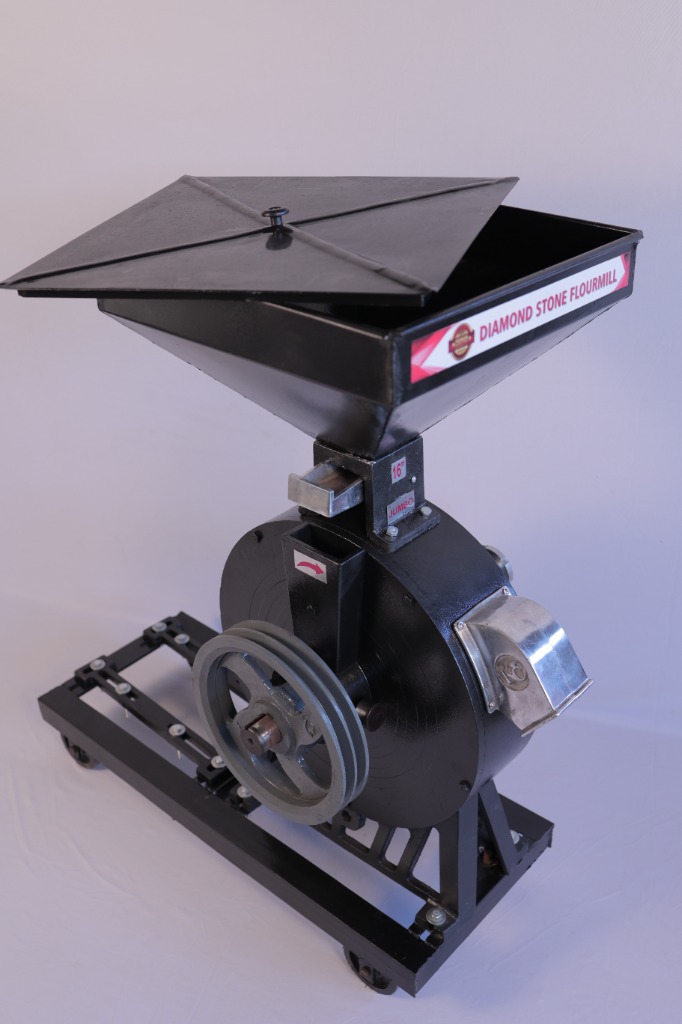
| 16" | 70–80 | 5–7.5 HP | Large flour shop, high-volume areas |
| 18" | 110–120 | 10–15 HP | Industrial / bulk flour mill business |
Which Size Is Right for Your Atta Shop?
14-inch — The Sweet Spot for Most Atta Shop Owners
If you are setting up a new commercial atta chakki in a residential area, a market, or a kirana-adjacent shop, the 14-inch commercial flour mill is almost always the right starting point. Here is why:
- Runs on a standard 3-phase commercial connection — available in most commercial areas across India
- 20–25 kg/hr output is enough to serve 30–40 customers per day comfortably
- Lower initial investment vs. the 16" or 18"
- Compact enough to fit in a small shop (100–150 sq ft)
The Kapi Poonamdeep 14" is the best-selling model in our lineup because it hits this balance perfectly. It is trusted by thousands of atta shop owners across Maharashtra, Gujarat, UP, and Punjab.
16-inch — For High-Footfall Locations
If your shop is on a busy market road, near a large housing colony, or you plan to serve 60–80 customers per day, the 16-inch model is a serious upgrade. With 70–80 kg/hr output, it can handle nearly 3× the volume of a 14" machine. The jump in output is significant because the stone diameter is larger — the same RPM covers far more grinding area per rotation.
Electricity consumption is manageable for the output — at 5.5 KWH rated consumption, your cost per kg of flour ground is actually lower than with a 14" running twice as long.
18-inch — For Industrial-Scale Milling
The 18-inch industrial flour mill is not typically an atta shop machine — it is designed for full-scale flour milling operations: rice mills, agricultural centers, large-scale packaging businesses. With 110–120 kg/hr output, it can grind over 1,000 kg in a 10-hour shift. If you are processing flour for retail packaging or supplying flour wholesale, this is your machine.
Diamond Stone vs. Standard Emery Stone: Which Is Better?
This is the most important technical decision that most buyers overlook. Traditional emery stone flour mills require Taki — a process of dressing (resurfacing) the stone every few weeks to maintain grinding efficiency. Each taki session takes 3–4 hours, requires a specialist, and costs ₹500–₹1,500 in labour plus machine downtime.
Kapi's Diamond Stone technology eliminates this completely. The proprietary hardened composite stone maintains its surface sharpness for years without any dressing. For a commercial atta shop running 8+ hours a day, this means:
- Zero taki cost — save ₹8,000–₹15,000 per year
- Zero downtime for stone dressing
- Consistent flour quality throughout the stone's life
- Cooler flour — the stone's efficiency means less heat generated during grinding, preserving wheat nutrients
What Is the Price of a Commercial Flour Mill in India in 2026?
Commercial flour mill prices in India vary significantly based on size, stone type, motor quality, and brand. Here is a rough market range as of 2026:
- 14" commercial atta chakki: ₹18,000 – ₹35,000 (without motor)
- 16" commercial flour mill: ₹25,000 – ₹55,000 (without motor)
- 18" industrial flour mill: ₹40,000 – ₹80,000 (without motor)
Always factor in motor cost separately (3 HP motor: ₹4,000–₹8,000; 7.5 HP motor: ₹12,000–₹20,000), installation, and transport from the manufacturer. Contact Kapi directly for current pricing — we offer the most competitive rates in Maharashtra and supply PAN-India.
How Much Can You Earn with a Commercial Atta Chakki?
Let us run a quick example for a 14" machine:
- Daily grinding: 80 kg (8 hours × ~10 kg/hr actual throughput with customer wait time)
- Grinding charge: ₹5 per kg (market average)
- Gross daily income: ₹400
- Monthly gross income: ₹12,000
- Electricity cost (3 HP, 8 hrs/day, ₹8/unit): ~₹1,400/month
- Net monthly profit: ~₹10,600
With a 16" machine at higher volume (200 kg/day at ₹5/kg), monthly net profit can exceed ₹25,000–₹30,000. Use our free ROI Calculator on the homepage to calculate your exact estimate based on your state's electricity rate.
5 Things to Check Before Buying a Commercial Flour Mill
- Stone technology: Is it Diamond Stone (zero-maintenance) or standard emery? Emery stones will cost you time and money every month.
- Motor phase: 14" and above require 3-phase power. Confirm your shop has a 3-phase commercial connection before ordering.
- Build quality: Check the thickness of the body casting. Cheap machines use thin sheet metal — they vibrate heavily and wear out in 2–3 years. Kapi uses heavy gauge steel and cast iron bodies designed for 15+ years.
- After-sales service: Who will repair it if something breaks? Ensure the manufacturer has a service team or dealer network in your state.
- Genuine spare parts availability: Cheap brands often discontinue parts after 2–3 years. Choose a manufacturer like Kapi that has been in business since 1996 with a national dealer network.
Why Atta Shop Owners Across India Choose Kapi Poonamdeep
Kapi Mill and Machinery has been manufacturing Diamond Stone flour mills since 1996 — nearly 30 years of consistent quality. We are ISO 9001:2015 certified, have 250+ dealers across India, and have served over 1,00,000 customers from Surat to Bihar to Jaipur.
Our machines are built heavier, run quieter, and last longer than comparable models in the market. And with our video call installation support and after-sales service, you are never alone after purchase.
Ready to Get a Quote?
Chat with our team on WhatsApp — we'll recommend the right machine for your location, budget, and production needs.
WhatsApp Us Now →हिंदी में पढ़ें
भारत में आटा चक्की की दुकान के लिए सबसे अच्छी कमर्शियल आटा चक्की कौन सी है? यह सवाल हर उस व्यक्ति का है जो नई चक्की खरीदने की सोच रहा है।
14 इंच — ज्यादातर दुकानों के लिए सबसे सही
यदि आप एक नया कमर्शियल आटा चक्की व्यवसाय शुरू कर रहे हैं, तो 14 इंच पूनमदीप आटा चक्की सबसे सही विकल्प है। यह 3-फेज बिजली कनेक्शन पर चलती है और 20–25 kg/hr आटा पीस सकती है। एक दिन में 30–40 ग्राहकों को आसानी से सेवा दे सकती है।
16 इंच — अधिक ग्राहकों के लिए
यदि आपकी दुकान भीड़भाड़ वाले बाजार में है और आप रोज 60–80 ग्राहकों को सेवा देना चाहते हैं, तो 16 इंच कमर्शियल आटा चक्की बेहतर है। यह 70–80 kg/hr आटा पीसती है।
डायमंड स्टोन का महत्व
कपि की डायमंड स्टोन तकनीक से पत्थर की टकाई (Taki) की जरूरत नहीं पड़ती। इससे हर साल ₹8,000–₹15,000 की बचत होती है और मशीन की डाउनटाइम भी नहीं होती।
अधिक जानकारी के लिए या कोटेशन लेने के लिए, हमें WhatsApp पर संपर्क करें: +91 82911 12613